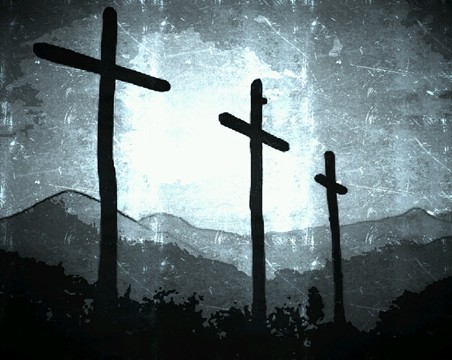
Ash Thursday

ashwednesdayThe imposition of ashes was yesterday – of course,
I know that much.
The calendar said so…
The liturgy dictated it…
I even carried out – despite a snow shriveled congregation huddled in a sanctuary being renovated – carpets removed, chalk lines on the floor and walls, electric lines dangling like tongues from the wall.

I thought about the dust swirling about us…
Of course, it was carpet fiber…
Of course, it was wood dust and plaster.
But perhaps, just perhaps, among the sixty year old carpet ripped from its resting place
there were the long ago deposited cells of saints now in glory.
It took my breath away, this thought, and tempted me to breathe deeper still.
We talked about that.
Listened to a reading about dust and ashes, ashes and dust.

And thirteen times
I dipped my index finger into the oily black mess
of burnt palm branches and
God only knows what else that settled from our place of worship.
(Yeah, I’m different that way…I use my thumb to push back stray hairs.)
I made the sign of the cross on foreheads.
I said the words, “You are dust, to dust you shall return.”
We prayed.
We sang.
We stared at the different crosses one pastor/artist could create on the canvass of skin.
We laughed and we left.

But today is “Ash Thursday” for me.
I look at that paintbrush which is my index finger
and I see it.
The ashes,
the dust
that has embedded itself deep into the quick of my finger.
Only a painful cut with the nail clippers will erase its presence.

Yet before I pull out the eraser,
I am reminded
that this is the first time,
the only first time,
that my Dad is among those saints remembered as dust, celebrated as ash.

He is embedded deep too.
Not just in the quick of my finger but somewhere quite deeper…
in the ganglia of my nerves…
in the composition of my cells…
in the foggy clarity of my memory…
in the power of my family system.
Cut off from the family – but present still.

I can cut out the ashes on my recognition of Ash Thursday,
almost as easily as I wiped the cross from my increasing forehead.
But some dust, some ash will remain deep.

Maybe that is why we were told not to look for the living among the dead –
We can easily find the dead among the living…
Look in a mirror…
Listen to a laugh…
Talk to a child…

It’s Ash Thursday for me…and I thank God I am happy for that!

Profession NOT Possession

A sermon for Princeton First United Methodist Church, September 13, 2015…

Mark 8:27-38

041314_1740_ACrossBetwe1.jpgI was standing outside the “Princess Playhouse,” the local community theater in Mt. Hope. I was waiting on others to arrive for the rehearsal scheduled that afternoon and evening. I was thirteen or fourteen at the time and really didn’t expect much to be happening on the streets while I waited.

To kill time, I decided to look over the copies of the playbills that were displayed on the walls outside the entrance to the Princess. I read one from ten years before and then started to look at the playbill for the production of Count Dracula we had performed the previous Fall.

In the midst of my reading and daydreaming I suddenly heard a loud voice behind me say, “Friend, do you know Jesus?”

I’m not sure if the two young men who had snuck up behind me thought they would get extra points for sending a teenager straight to heaven by scaring him to death or if they thought this was a particularly effective evangelistic approach. I can tell you from experience, however, that they were much closer to succeeding on the former than they were ever going to get on the latter with me.

After composing myself I turned around and gave them my best United Methodist Youth smile and said, “Why yes. Of course I know Jesus. I go to the United Methodist Church just over the hill there.”

“Well,” the young man who had not scared me said, “you may have learned about Jesus in Sunday School but do you know him?”

The other joined in as he opened a Bible he was carrying, “The Bible tells us that all have fallen short of the glory of God.” He let me glance at the moving Bible page. “And it tells us that Jesus came into this world to save us from our sins but we have to accept him in our heart and confess him with our lips.” He flipped through a couple of bookmarks he had in the Bible and let me see the words blur by my eyes.

“So,” the second one asked again, “do you know Jesus well enough that if you stepped off that curb and got hit by a car that you would be assured that you went to heaven?”

I just blinked at them a couple of times and said, “Yes. I do.” And I turned around and kept reading.

I heard their feet shuffle a few times and then finally one of them said, “We will be praying for you, brother.” Thankfully, he said this as they were leaving.

This text we just read from Mark’s gospel is one about some people who definitely “knew” Jesus. At least, it is about those people who were closest to him, who shared their lives with him, who witnessed the work that he did and gave up all they had to follow him.

In a conversation with them as they are walking along some road Jesus asks them, “Who do the people say that I am?”

I’m sure that those who knew Jesus so well wanted to show that they were paying attention to the crowds around him and they offered the many answers that they heard.

I imagine that there was bit of silence – not really silence but more of just the sounds of people walking for a few minutes while those answered hung in the air – before Jesus asked his second question, “Yes, but who do you say that I am.”

I can almost hear the gravel sliding as Peter comes to an abrupt halt on the roadway and answers Jesus, “You are the Messiah.”

The whole group stopped when Peter said this – at least in the way that I see it happening – and Jesus kinda nods and then does something rather odd. He sternly orders them – not asks them nicely, not laughingly tells them – but sternly orders them to tell no one about him.

There is another account of this conversation in another Gospel that tells us a bit more about Jesus’ response to Peter but that didn’t matter much to Mark. At least not enough for him to include it in his account, so we will go with Peter’s answer that he knew Jesus well enough to profess him as Messiah and Jesus sternly orders the whole group not to tell anyone about him.

A rather odd way to get a movement going, don’t you think? Don’t tell anyone about it.

Scholars have used gallons of ink and preachers like me have thrown around millions of words about this whole idea of Jesus telling the disciples to be quiet about who he is. I have been and obviously am going to be another one of those participants today.

I think the key to understanding why Jesus said this is in the several verses that follow this warning. The ones where Jesus explains exactly what being the Messiah meant to him. The ones where Peter tries to treat Jesus like a child and scolds him about saying such things. The ones where Jesus calls Peter Satan for just thinking about himself and human things rather than the heavenly, kingdom things. You hear it also as Jesus says to the disciples, “If you want to follow me, deny yourself and take up your cross and follow me.”

Deny yourself – means setting aside your own agenda. Take up the cross means that we acknowledge when we are following Jesus things are not going to be so clear and easy, they are going to be messy. Things are going to get rough.

It is clear from these words that follow Jesus’ order to the disciples to not talk about who he was that Jesus was worried that maybe disciples have a hard time figuring out how to explain Jesus and they do much better when they just follow Jesus.

In other words, for disciples then and now, this lesson from Mark is telling us that our profession of faith must never be one in which we take possession of Jesus – instead, our profession is to possess the cross. We are to give up our own agendas, our own thoughts of what God should be and let Jesus be the leader, no matter what.

Peter and the rest of the first disciples had a difficult time with that way of living. Jesus knew it and thought it best to tell them to be quiet.

Disciples today? Well, I think if we are honest, it is still a struggle sometimes.

The pastor was happy to announce to the small country church that an anonymous donor had given a gift to the church in order for the Trustees to outfit the church with chandeliers. The Trustees would hold a meeting later that afternoon to decide whether to accept the gift or return it to the donor.

The meeting time came and people who felt both ways about the gift came ready to fight.

“If God had intended for chandeliers to be in this church, we would have had them a long, long time ago,” said one side.

“God means for us to have these chandeliers, or else he wouldn’t have put it on the heart of someone to donate them,” said another side.

The arguments went on and on. Neither side willing to budge even after an hour or so of debate. The resorted to name calling. They resorted to questioning the faith of one another, the donor and the pastor. The arguments went on till it began to get dark outside and darker inside.

Finally, the one person who hadn’t said a word throughout all the meeting cleared his throat and said, “Folks, I don’t know much about chandeliers – don’t know nothing about them actually, but I will tell you this. What this church needs is some light!”

Sometimes, the church does need some light. Especially when they fight with each other over earthly things rather than focus on the heavenly, kingdom things of being one in Christ.

Over the past several weeks, many of us have witnessed a battle which has caused mind-numbing damage to Christianity. The battle took place in a circuit clerk’s office and in courtrooms in Kentucky as well as in front of the watchful eye of the entire world.

First of all, I know that many people have feelings about whether Kim Davis should issue marriage licenses or not. Many people have strong feelings about the whole same sex marriage issue that has risen to the forefront of our society. Our church has been engaged in conversations about sexuality and faith for almost my entire life – and people feel very strongly about things one way or another.

Second, I have restrained from saying anything about this latest battle because I know how easily it is to be misunderstood when someone already disagrees with me. It is hard to speak when we don’t know if anyone is really listening. I know it is equally difficult to listen when I don’t like what someone is saying to me.

However, regardless of how we feel about same sex marriage and the battle continuing in Kentucky, I hope and pray that we can all see why sometimes Jesus tells us to just keep our mouths shut when it comes to telling people who we think he is.

On the same sex marriage side of these demonstrations, I have heard people completely disown their brothers and sisters in Christ who choose to act differently than they would in these circumstances. I have heard vitriolic, hurtful name calling. I have seen hate filled signs from the side of this argument that starts their position by saying “Jesus loves all sinners.”

AND, on the side of Kim Davis and her supporters, I have heard people completely disown their brothers and sisters in Christ who choose to act differently than they would in these circumstances. I have heard vitriolic, hurtful name calling. I have seen hate filled signs from the very people in this argument who say Jesus is their Savior and Lord.

You see, the saddest part of all this is that both sides lay claim to Jesus as Messiah. And they do so loudly, so all the world can hear.

Is it any wonder that sometimes, sometimes, Jesus just looks at the disciples and sternly tells them not to tell anyone who they think he is.

The only one winning in this battle in Kentucky is Satan, because all of us Christians just can’t seem to keep from dragging Jesus into our battles.

A person I follow on Twitter, an author named Doug Bursh, made this comment this week: “I think we might need fewer reformers and more repenters. Perpetually pointing out the sins of others makes us annoying.”

I believe we have seen Christianity take a mind-numbing blow in the hearts and minds of many people who have not yet met Jesus. And it is going to hurt us all in the long run.

Our profession of faith must never be one in which we take possession of Jesus. Instead, our profession is to possess a cross and help one another carry it when necessary.

Confession and Pardon

Stronger than stones that seek to silence
is the power of a single word:
mumbled,
uttered,
spoken,
wept,
shouted,
written,
or even scratched into the shifting sand.

A Feast for Crows

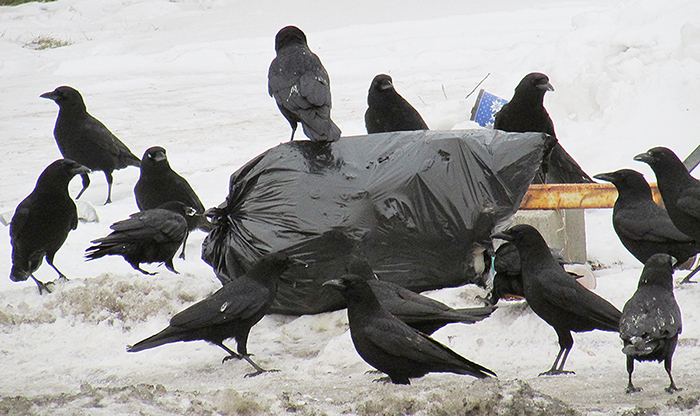
The black plastic creature half-sat on the yard but allowed its weighty bottom to take up residence on the asphalt.
It waited.
It waited alone for its predestined journey that that place we use for all of that we call useless.
But it did not wait alone.
A murder of crows pecked and ripped at it skin seeking nourishment from somewhere within.
The creature’s innards were inspected – then accepted, ingested or rejected yet again.

A feast for crows.

Not mine...really...but a great picture.
   

Perhaps. But so much plastic, so many barriers stood in the way of true feasting. It was nourishment, yes. But mere survival.

Day by day, by day, by day, I too picked through the leavings of the disciplines I dared to name spiritual.
I hungered. I hungered for the Creator of “All-That-Might-Be” feeding me through Word, music, prayer and yet hidden and protected beneath barriers of anxiety, filaments of failure and membranes of loss from days long past.
I ate to exist from this creature I called “daily disciplines”.
I ingested to exist but I would never take flight on these protected rations.

I knew there was a feast in there, somewhere, but like the murder with wings, famine prevailed.

Who kept those crows from their feast?
I confess it was me.
I was the one who fashioned the slouching, enticing, lying plastic creature.

Who kept me feeding on crumbs from the Table when somewhere near I inhaled and knew a Feast had been set?
I confess it was me.
I created the picker and ripper of Spirit.
I tied myself to my worries and plastered scars of loss on myself that were tougher, deeper, less wielding than even the thickest of plastic bags.

I think now the crows would desire hope.
They would hope for the power to name their nemesis and in so naming vanquish its power over them to keep them from the feast.
I think, if they could, the crows would hope.

For my part – I am thankful. Thankful hope is a gift given to me.

I thank the one who refused a drink – refused a drink as death swallowed him whole. And yet was the one who kept me alive through crumbs thrust from the Table over which he presides.

I have hope.
I can name my nemesis even/especially when it is me.
I can open the vessel of feeding by shedding the ties and the scars.
I have hope because one who once was bleeding was always, always feeding.

Let the feast begin again.
Music? Wine? Color? Scripture?
Or just this confession of words.
Holy manna for me – a feast for crows.

Clergy School 2015 – An Interview with Our Preacher

The West Virginia Annual Conference sponsors an annual continuing education event for Clergy. This year our event will be from October 13 – 15 at Blessed John XXIII Pastoral Retreat Center in Charleston. A link for registration is right here.

In order to introduce you to one of our primary speakers – our preacher for the event – I have done an email interview with Rev. Tim Craig. Please use this to get to know our preacher a little better and keep him in your prayers as he prepares to bring us God’s Word for this event.


Scott: “Tim, tell us a little bit about yourself – your background, your family, your work history, and even some of the things that you do that make your unique?”

Tim and Ann CraigTim: I grew up in an Irish Roman Catholic family and attended Loyola University in Baltimore, Maryland. It was there at Loyola that I started to feel a call into the ministry. But at the same time I wanted to get married and have a family … things you can’t do or have as a priest. When I talked with a priest, he recommended that I look into other denominations. That was a real gift from that priest.

I attended a United Methodist Church and felt right at home. What sealed the deal for me was when the pastor said that the communion table was open to everyone and not just members.

I met my wife Ann through mission work. We both served in youth ministry.

Ann and I have four kids; three daughters and one son. I have three in college. My son and my youngest daughter go to VA Tech. My middle daughter is at George Mason University. My oldest daughter graduated from Mason and now works as a Program Director at Wesley UMC. Ann is a first grade teacher. We have been married for 25 years.

After college I taught high school algebra for a few years. I went into the business sector for a few more years and worked for ADP (Payroll Services). I started seminary (Duke Divinity) in 1991. I was a student pastor while in seminary. I served an “eventful” two-point charge in southern Virginia. From there I served as an associate pastor of a large church in Richmond. From there I went to serve a mid- sized congregation. After only two years in that appointment I was appointed to a church in Northern Virginia that had significant conflict. I stayed there for eight years. The church worked through the challenges and turned itself around. I was then appointed to serve a large church in Arlington, Virginia. After five years of ministry in the hustle and bustle of the metropolitan DC area, I am now serving Great Bridge UMC in Chesapeake, VA.

I love the Chesapeake area. It is much slower paced and I am 30 minutes from the beach. My family and I love the beach. We go to relax, fly stunt kites, collect shells, walk, and hang out with friends. The beach truly rejuvenates my soul.

I love music and I love being around people. Love Jesus with everything I have.

A few years ago, I was inspired by Rev. Sue Nilson Kibbey’s work with Gallup Strength Finder. She uses the StrengthsFinder 2.0 test to help you see your strengths in ministry. My top five strengths are: Connectedness, Positivity, ideations, Achiever, and Adaptability.    


Scott: “How much do you know about West Virginia? (You can be honest…as long as you don’t say that you didn’t realize it was a separate state!)”

Tim: Well … I know some. Great Bridge UMC takes about 2 to 3 mission trips to Iaeger, West Virginia every year. I’ve been on two trips so far. We work with Little Sparrows Ministry. I even attended the McDowell County fair last year. I ate fried oreos! Quite a treat.  

Scott: “If I am not mistaken, you are the one who introduced my family to Bar-B-Que Oreos…I still have the mouth burns to prove it, actually! Glad you picked on the Southern WV Oreo tradition!

I also understand that you were a recent participant in the Royce and Jane Reynolds Program for Church Leadership in North Carolina. What was that experience like and what was your main take-a-way?

Tim: I attended the Royce and Jane Reynolds Program for Church Leadership. It is a great program sponsored through the Western North Carolina Conference and taught through the Center for Creative Leadership in Greensboro, North Carolina.

The program is two part. The first part consists of developing one’s leadership potential. The second part focuses on leadership needed in the local church.

My main take-a-way was the need to really focus on and develop clarity around mission/ vision and core values. We find ourselves stuck in maintenance mode so many times because we overlook these things in the local church. Busyness is often the culprit.

If your conference ever gets chance to work with Russ Moxley or Janice Virtue from the Center for Creative Leadership, I highly recommend it. I know the Virginia Conference has put together a leadership program with Russ. It is in year two. Participants from last year really enjoyed it and learned a lot. (Tim Tate took the program last year. He would be a good point of contact too.)


Scott: What have been some of your formational moments in building relationships with people who have greatly different theological positions than you hold? How is that going to be helpful to you as you prepare?

Tim: I have to tell a story to answer this one. My mother and father divorced when I was young. My father and I were not close. He was a strict Roman Catholic. I know. I know. Divorce and strict Roman Catholic do not go together on paper. Then there is life.

Both my mom and father remarried. My father and his wife had more children.

My mom would call my father when I needed some fatherly chastising. When I left the Roman Catholic Church to unite with the United Methodist Church, my mom called my father. We talked and the last words that he said to me where these, “You are no longer my son.”

My father died of pancreatic cancer. When he was passing he said to his children, “Tell Tim I love him too.” They had no idea who Tim was and so my oldest brother began to ask questions and started searching.

A few years after my father’s death, my brother tracked me down. We met and I now have 5 new siblings as well as a mother-in-law.

My father’s last words were not “you are no longer my son”; they were words of love. And that is the theological position that is by far the greatest and the one that is formational and foundational for me.

It is tested often but love is the greatest and love conquers all.

A few years ago, Westboro Baptist Church came to picket the congregation I was serving because we had a woman pastor. In response, we changed the preaching schedule around and she preached on the Sunday that they came to picket. We had record attendance that Sunday. While they shouted obscenities filled with hate, we responded with love. It was a great day. The headline from the newspaper that covered the event stated “love drowned out the hate message”. Amen to that!


Scott: As you know, the theme for this year’s Clergy School is “Passing the Bread, Keeping the Peace” – a reference to the times that we live in as United Methodists. There is a lot of division and much of that division is centered on the church’s policies and practices concerning LGBT issues – same-sex marriage, ordination, membership, and full inclusion are all being discussed quite a bit. As the preacher for this event, what do you hope to bring to the pulpit that would help those of us who are on very different sides of these issues to maintain a “common Table?”

Tim: The writer of Hebrews once sermonized, “Make sure that no one misses out on God’s grace.” (Hebrews 12: 15) Whatever the side we take this needs to be who we are. Period. And this becomes even more important to us as United Methodists who believe that God’s grace is prevenient, justifying and sanctifying.

Grace is where I see hope. Always have and always will. While homosexuality is the hot topic sin of the day, I am sure that it isn’t the only sexual sin that is out there. And for that matter, I am sure that it isn’t the only sin that is out there. Of course someone is going to read this and say “he just called homosexuality a sin” and that’s not the point that I am making. If you see homosexuality as a sin then I have to ask; what are doing to make sure that these children of God do not miss out on the grace of God? Are you willing to have a heart like Christ that from the cross proclaims “Father forgive them”? If you see homosexuality as not a sin, can you offer grace to those who have been taught by the Church for centuries that it is? Can you come alongside these folk and have honest conversation without being equally judgmental toward their position?  

In a nutshell, what I hope to bring to the pulpit is a reminder of the importance and power of grace and that this grace is what is needed for both sides as we come to the common table.


Scott: If you could recommend a book in the Bible for participants to read in preparation for this Clergy School, which one would it be?

Tim: I would recommend that you read the gospels. I know you asked for one book but read all four of the gospels. In addition, read them in such a way that the words about Jesus live for a purpose other than preparing a sermon! We get so used to reading the Bible for sermons; I think it is important to read the Bible from time to time as God’s story.


Scott: If you could recommend a non-biblical book to be read – which one would it be?

Tim: Wow- this is a tough one! I read a lot. I think for the topic of grace I would read Phillip Yancey’s “Vanishing Grace.” For leadership principles I would ready Ron Heifetz’s “Leadership on the Line” or Russ Moxley’s “Leadership and Spirit.”

Scott: Tim, thanks for taking time out of your schedule to share with us! I’m sure this will help everyone prepare for our time together. I will take your suggestions about the Bible reading seriously and will look into the leadership books as well.

Once again, you can register for this year’s Clergy School right here. We look forward to seeing as many WV Clergy there to welcome our Virginia colleague!!

Scott: Oh, one more question: How do you feel about a back-to-back championship for the Blue Devils this year?

Tim: Do you have your final four tickets yet? If you are a Duke fan, I would start booking now. And somewhat prophetic to the theme of the clergy school, if the new recruits play together as a team, it will be another championship for coach K.