righteousness and mercy – a sermon

I invite you to join me in prayer. Would you pray for me even as I pray for us all?

Lord, it is not by might, it is not by power, and it most certainly is not by the cleverness of this human’s imagination that your word is read or proclaimed. But it is by your spirit. So may that spirit come now. May it rest upon each of us. May it work through all of us that we find ourselves in the presence of the Living Word, Christ Jesus our Lord.

Amen.

From Luke, chapter 19, verses 1 through 10.

Jesus entered Jericho and was passing through it. A man there named Zacchaeus. He was a chief tax collector and was rich. He was trying to see who Jesus was, but on account of the crowd, he could not because he was short in stature. So he ran ahead and climbed a sycamore tree to see him, because Jesus was going to pass that way.

When Jesus came to the place, he looked up and said to him, Zacchaeus, hurry and come down, for I must stay at your house today. So he hurried down and was happy to welcome him. All who saw it began to grumble and said, he’s gone to be the guest of a sinner. Zacchaeus stood there and said to the Lord, look, half my possessions, Lord, I will give to the poor. And if I have defrauded anyone of anything, I will pay back four times as much.

Then Jesus said to him, today, salvation has come to this house because he too is a son of Abraham. For the son of man came to seek out and to save the lost. This is the word of God for us, the people of God.

Thanks be to God indeed. You know, folks, over the past several weeks as we’ve gone through this Lenten series entitled Everything in Between, we’ve been wrestling a lot and digging deeper into a lot of parables. You know, we had the Good Samaritan, we had the parable of the barren fig tree. We had a parable about lost and found sheep and a shepherd risking everything. And the one week here in Lent that we didn’t have a parable, we had to deal with the family drama between Mary and Martha as they tried to figure out who was doing the better thing.

So to tell you the truth, I was looking forward to dealing with some very straightforward up front story from the life of Jesus this week. Something concrete. Jesus walking through a town, a tree, crowds, something without all that having to dig into parables and find all the meaning that’s in those parables. Something besides all the family drama that we’ve had to deal with.

Used by permission of A Sanctified Art

And then, of course, we get to Zacchaeus.

Zacchaeus. The name Zacchaeus means righteous or pure. Did you know that righteous or pure is what this man is named? I mean, really, a Roman tax collector named that?

I mean, let’s be real. What’s the one word that is literally connected with tax collector in the gospel? With the conjunction and tax collectors and sinners. Yeah, tax collectors and sinners, exactly. And this one is named innocent and pure.

Not much of a break there. And as I studied a little deeper into this parable, I discovered that there were some interesting problems dealing with the original language of the parable. The original Greek is not so clear as to when it was that Zacchaeus started all this charitable giving that he was doing. Now, I don’t want to get. I don’t want to get lost in the weeds here or the thorns or go climbing up my own tree here and end up having nobody see or hear what I’ve got to say.

But suffice it to say, Zacchaeus could have been doing this giving and repaying for quite a while. Could have, just because of the words that are used in the original language. But what we do know for sure is that Zacchaeus went public with it after meeting Jesus. He declares what he’s doing and will do, and that changes a lot.

But still, as I was preparing for this week, I had to dig down into the roots of those words. Like that gardener dug down into that fig tree. I had to search like I was looking for a lost sheep in the wilderness. I began thinking, you know what? This might as well been a parable.

There was no break here.

And then, of course, there’s Jesus.

Jesus, there he goes and singles out this tax collector from the crowd. Zacchaeus, the man too short to see and too despised to be seen.

Zacchaeus, hiding in a sycamore tree, a man whose name was, to put it as mildly as you can, just a touch at odds with his reputation.

A man everyone knew was making money by taking money.

I tell you what, this series of everything in between really has drawn our eyes to the dichotomies that we can find in the world and even within scripture itself, dichotomies sometimes that we love to see. I mean, things like righteousness, we like that we can look at someone or something and say, that’s righteous. We know that’s good. It may even be trouble, but it’s good trouble, so we know that’s good. Righteousness, something we can look at and define.

And mercy, we like that, too, because we want to show mercy to those who deserve it, right? I mean, someone needs to deserve mercy. If you don’t believe me, just ask any old court judge. Or you can ask a young one, too. We’ve only got old ones in here today, though.

I think we like to keep our categories like righteousness and mercy separated.

But Jesus, well, Jesus doesn’t care all that much for our categories.

Jesus doesn’t see like we do. Jesus doesn’t even look in the same places we do for what needs to be seen in the story. Jesus sees: Zacchaeus, sees him up in the tree, hiding.

But Jesus sees him not as a tax collector, but as a human being. Jesus sees Zacchaeus as a child of Abraham.

And then Jesus just invites himself right into that person’s house, into the mess that is a tax collector’s life, into that space, that space that’s seemingly miles wide between righteousness and mercy. That’s where Jesus goes.

And that’s just it, isn’t it? That space between – that awkward, uncomfortable space where we don’t know what to do, the space where we’re not sure if we should be angry, judgmental, frustrated, or just compassionate.

That space where we must wrestle with verbs, when it comes to how we act.

A space where we must wrestle with names and labels and all those things. That space, that uncomfortable space where we must deal with, well, people.

We want it to be nice and easy one way or the other. Righteousness, mercy. Are they righteous? Do they deserve mercy?

And Jesus?

Well, Jesus fills that space.

Jesus doesn’t choose. Jesus just invites himself in. He stops at a tree and looks up and says, hey, you, I’m going to your house today.

Here’s Jesus looking where we don’t even want to look.

And in that moment, in that space filled with Jesus, something happens, something transformative. Zacchaeus, this person whose life was only known as the one who took from others, becomes and shows the whole community that everything is being made whole, everything will be made right.

Zacchaeus wants salvation, connection, community, not as a reward for being good, but as a gift freely given.

And Zacchaeus gets it. The community gets it. And that, my friends, is good news. Not just good news, but the good news. That’s the Gospel.

Jesus doesn’t just offer mercy to the undeserving and commend those who are righteous.

Jesus fills up the space in between.

Jesus fills up the space that is unfillable and even uncomfortable for us to go there.

Jesus brings together that which is broken, you know? Here, in just a few moments, Jesus will offer himself to you again in the act of taking apart of the broken body of Christ, we will be brought together in community.

It doesn’t seem to make sense, does it? In brokenness, there’s community.

But that’s what Jesus does. Jesus fills the spaces between those things that we have trouble filling.

Salvation, my friend, my siblings, salvation is offered to you today.

Come, come on down and let Jesus go to your house today. Amen. Amen.

As you leave this place, may you find God in every messy middle. May you know that the world is bigger than any two sides. May you trust that you are made in the image of God. Therefore, you contain multitudes. So may you move through the world with an open heart, with a curious mind, and with the confidence that you do not go alone.

God is with you in the mountains, in the valleys, and everywhere in between. Believe this good news and go in peace. Amen. Amen.

Truly Great News – A Review of “How the Bible Actually Works” by Peter Enns

WiseBibleI have read (and used as teaching tools) two of Enns’ previous works: The Sin of Certainty and The Bible Tells Me So. Thankfully, I was able to receive an advance reader copy from HarperOne of How the Bible Actually Works in exchange for writing a review and being a part of the launch team for the book. And even though a well-meaning colleague (and supervisor for that matter) called me a heretic for carrying around the copy, I am more than happy to fulfill my obligations before being burned at the stake.1

However, it was with some other fear and trepidation that I approached this particular work of Enns’. The subtitle set off little alarm bells in my United Methodist self – “*In Which I Explain How an Ancient, Ambiguous, and Diverse Book Leads Us to Wisdom Rather than Answers – and Why That’s Great News.” The word “ambiguous” was one that I do not believe that I had ever heard in serious Biblical Scholarship before. I chalked the subtitle up to Enns’ tendency toward the sensational and sometimes sarcastic and dove right in.

I have no problem seeing the Bible as either “ancient” or “diverse”. I have known for quite some time that it is important for us to understand the context of the Biblical writers and realize that the Bible does come from divergent opinions. I must say, however, that Enns breathed new life into the whole historical critical study method in several ways in How the Bible Actually Works. By nailing a third leg to this milking stool for the Bible, namely the thought provoking word “ambiguous,” Enns is able to show how to use the ancient, diverse text in new ways.2

Many people, including the most traditionalist of Bible readers, make the claim that “the Bible proofs itself” and that we should only judge “Scripture with Scripture.” Very few mean it. Peter Enns, however, doesn’t just mean it, he encourages us to start and finish our work with it. By using the way the Bible itself is structured, he challenges those of us who wish to take The Book seriously to read the Bible in the same way it written.

In an adroit manner, Enns prompts us to see a link between revelation (the act, not the last book of the Bible) and imagination3. Since biblical authors came from different times and were experiencing faith in sometime very different situations than previous people of faith – one just doesn’t know how important the Babylonian exile can be to faith until they read this book – what was revealed to their imaginations about God were quite different over time. Enns rightly calls this process of taking what was previously learned about God, adding the current experience, and working out what God is saying to the Biblical writer for that time, an act of wisdom. (Note to Enns and publisher…kill the capitol on “wisdom” in the subtitle…that usage makes it seem like the whole of Biblical writing is pointing back to the genre of Wisdom literature.)

But that is not the great news he has for us in this book. No. The great news is that by following the pattern of Biblical writing into current day Biblical interpretation, we are invited to continue the act of finding wisdom in the Bible rather than twisting and proof texting to some absurd level to try and make the Bible into some book of rules that should be followed. The living Christian faith is not basketball and we should not treat our bible the same as the rules for basketball. Yeah, Enns is stuck on baseball and that pinstripe wearing team of hackers from New York City, but we all know the best sports analogies come from basketball.4

As I said earlier, I read and taught from two of Enns’ previous works. At the end of them, I, along with others, were wondering, “Okay. This is good, but ‘what’s next?’” How the Bible Actually Works offers that “what’s next” and opens up the whole of creation for the human endeavor of understanding God as revealed in and through the Bible.

Is this book perfect? Far from it. Some, but not me, will indeed be put off by the lack of “scholarly sounding” writing. Others, like me, will tire of Enns promising “more on that later” – which I would humbly say is a real fault in his writing style. I didn’t go back and actually check, but I do not believe Enns came back to every single thing that he said he would. If I am wrong, I apologize, but it makes my point for me. There were too many of them to keep up with and I’m just short of being compulsive enough to go back and check each one. May those with eidetic memories make the proof that is needed!

Even with those slight problems, this is a great book. It needs to be read and reread often by those who take seriously the Bible and especially those of us who regularly teach and preach from the Bible. We have abdicated through laziness the effort that is really needed to understand such a holy book and Enns has offered us the possibility of recovering not just the proper discipline we need, but the hope that using this discipline will break us out of our sloth and allow us to find new ways to unify the ever splintering Christian kingdom on earth.

May wisdom be with you. (Yep…I crack myself up.)

The book is released on February 19, 2019 so go ahead and preorder your copies. (Yes, you will want extras to give to someone else so that you can talk through some of this stuff.)
ORDER HERE.

#wisebible #harperonepartner

@PeterEnnsAuthor @peteenns

1 – I must add that no real harm should come to this reviewer. Said colleague gladly accepted the loan of the previous works…then again…that could be in preparation for my trial. Hmmmm.

2 – Okay. This may not be all that new even according to Enns. He acknowledges the existence of the Wesleyan Quadrilateral towards the end of his book. May I just say, “Glory be!” and refer you to note four on that response.

3 – There is a fair amount of use of the words “imagining” and “reimagining” in this book. Some may find it a bit too human of an endeavor for reading the Bible and understanding God. My only response is, “What else do we have left to use?” Imagination and revelation are “pneumatically” linked in humanity. Either that or we are all drunk. Just read Acts 2:15.

4 – Sarcasm. (Yeah, this note may be seen as plagiarism. So noted. They wanted me to write the
review. Consider this an instance where this writer wishes he had thought of this idea first and didn’t have to “borrow” it.)

A Journey Toward the Trinity? Searching for Sunday (A Review)

I am not a millennial. I live with two of them in my home – well, one is part time now that she has gone to college. However, I have always had a difficult time figuring out which group I truly relate to the most. I could be a “Boomer”. No doubt my bowing to the god of consumerism labels me this way many times. I could be a “Gen-X” or “Buster”. God, my supervisors and my colleagues in ministry know that I have spent more than my fair share of time calling things into question. I enjoy upsetting the status quo just a little too much at times. Although my age would allow me to fit into either of these two groups – I was born in 1965 – I truly think of myself as part of the “Bridge” generation. (We have no “one” identity but find our tribe among many.) Perhaps that is why, even today, I find myself longing to listen more and more to voices of the “millennials” who have a relationship with doubt and questioning that I find exciting and fascinating, if not, at times, downright frightening.

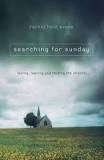
SFS BookIt is because of this desire to hear the voices of millennials that I first started reading Rachel Held Evans’ work. It is why I have listened to her speak. It is why I am honored to be able to recommend her latest work, Searching for Sunday.

When I received my copy of Searching for Sunday, I immediately scanned the table of contents for the section on Communion. I knew the book was going to be organized around the Sacraments and the Eucharist has special appeal to me because I have learned so much about following Christ by being on both sides of “the Table.” It was in serving communion that I learned what a bold-faced judgmental hypocrite I was when I chose not to partake of Christ’s meal with a congregation I was serving because I felt their sin of racism somehow tainted the meal. It was in receiving communion that I learned what a beggar for grace I am and now only approach the Table with my hands held out. Sometimes, I will sit through a whole worship service with my hands cupped just so I can remember that grace is a gift.

So I decided to read that chapter first and then go back and read the whole book. Perhaps I wanted to take the book for a test drive around a topic that is near and dear to me. Perhaps I wanted to see if the part of the book which would be most important to me would live up to my expectations. I don’t know. I just wanted to read that section first.

I was not disappointed. My expectations were not only met, they were exceeded. Ms. Evans echoed the feeling I learned at that table in North Carolina when I thought I was too good to eat with certain people: “At Eagle Eyrie I learned why it’s so important for pastors to serve communion. It’s important because it steals the show. It’s important because it shoves you and your ego and your expectations out of the way so Jesus can do his thing. It reminds you that grace is as abundant as tears and faith as simple as food.”[1]

The power in telling any story, I believe, is as that story invites the reader in and allows them to find themselves somewhere in the narrative. This happened to me in a powerful way as I read “Communion” and happened again and again throughout the book. I am not a child of the evangelical church, I am and always have been part of a mainline denomination, the United Methodist Church. But still, I found myself in Evans’ narrative over and over and over again. As powerful as this connection to the story was around “Communion” it paled in comparison to how I felt the “guilt of silence” as I read the section “Vote Yes on One.” Silence seems to be the only way to survive in the UM Church these days.

I simply cannot tell you how great this book is for anyone searching for a reason to find faith again, or those who are sometimes wondering about the faith they have in the tradition they hold. Evans’ story of her journey shows how one can embrace evangelical, progressive and sacramental traditions as they follow Jesus. And this is a story for our time.

Recently, I read an article by Steve Harper where he said, “Staying together is a sacred act – a holy experience. We have become patterned to disagree and divide. But the witness in the Trinity is to unite and to be one.”[2] Evans poignantly tells us the sometimes tortured path that she took to get to that unity of past, present and future in her theology. Evans gives us the hope that we might one day do the same.

Read Searching for Sunday. Start your journey as well.

[1] Searching for Sunday, Rachel Held Evans, Nelson Publishing, 2015, page 140

[2] “No More Sides”, Steve Harper, Circuit Rider Magazine, Feb/March 2015, The United Methodist Publishing House, page 27

Trust?

#writing201 assignment for the day…”Trust” as an acrostic with internal rhyme…yep…this was a challenge!


Trust?

Constant posturing, self-need driven bickering
Only leaves us all bleeding, endlessly needing.
Misusing our Book as a hook – to injure other’s belief –
Marking those who are in and those shrouded with sin.

Unless the flood of our blood ceases, quickly decreases
No body will share, even dare to come needy.
I will be me and not part of we.
One trusting no one is perfectly done.
Never to sup, sip a cup filled with love.


As a member of and a leader within the United Methodist Church, when I hear the word trust it brings about many very positive images. However, our current denominational mood might well be seen by some as one of mistrust or lack of trust of one another. This saddens me. The most important part of this poem to me is the acrostic that calls us to something greater.

An Apology, a Comment and a Response

First of all, allow me to offer my apologies to a faithful reader of this blog, Dr. Cory Williams. I failed to approve a comment he made in response to my last blog post dealing with questions about Scripture. I am sorry, Dr. Williams. Not sure why I responded to your post personally and failed to approve it, but I did just that. I feel certain that if there were fines that could be written for “bad blogging techniques,” this mistake would have landed me a whopper of a fine – right along with my failure to properly spell check my posts and my occasional overuse of “however”! I’d be broke being these fines. Continue reading “An Apology, a Comment and a Response”