A Response to “Unsettled Christianity” and “with Bishops abandoning the Discipline, are we a church?”

Please read the above article here before reading my response. Thanks!!

Joel Watts, once more you have given us a well written, concise article. You have given me much to think about and I believe, with a lot of hope and prayer, that we share more common ground than we do disagreements.

I agree that we need discipline in order to truly be a church. However, I don’t think the action of our bishops – or inaction for that matter – destroys our standing under the headship of Christ. How many times historically would this have taken place, if not just in the UM tradition then the Church universal? If the efficacy of sacraments are not dependent upon the “holiness” of the presider then how could we possibly say that the entire existence of an ecclesiological body such as the United Methodist Church lays solely upon the actions of its episcopal leaders?

At the same time, we are at a crossroads in our church. There is danger in the disorder we are facing. The fact that we live in a 24/7 news cycle world and that people use that cycle to proclaim what they believe makes our four year system of affirming and changing our Discipline seem rather quaint, if not almost useless. Even our conversations in and among blogs shows how quickly things develop. Yet, if you are a United Methodist, you must wait four years for any “real” change to take place. It reminds me of the old joke, “How many United Methodists does it take to change a light bulb?” “Doesn’t matter how many but you can count on it taking a full quadrennium to happen.”

I am not excusing misbehavior by our bishops, elders or any other member of our denomination. I do, however, understand how frustration can lead to demonstration. It was quite possibly frustration, I believe, that led Rev. Wesley to send Asbury and Coke to these United States (ok, they weren’t that yet) to do everything a bishop would normally do, but not be a bishop. I know Rev. Wesley didn’t wink and nod when he did this but it sure didn’t Coke and Asbury long to really fix the problem.

So, I think we might both agree that our Discipline needs fixed in such a way that we can actually be church in the 21st Century. What would that look like? Is that even possible? I don’t know. I just know that the times between Councils and Conferences, etc. throughout church history has become shorter and shorter. It used to take much longer to do theology and even cause schisms and reformations. Now we can do these within days.

Secondly, I disagree with starting our theology with ecclesiology. You say, “Christ is head of the Church; the Spirit dwells in the Church; we (who) are saved (are) in the Church. Our ecclesiology will reflect our views of those other important doctrines.” I would say, “Christ is the head of the Church and the Host at Communion and every other part of our theology should flow from there.” Ecclesiology must be secondary to Christology simply because of the chicken/egg question. Can we say, “There is no Christ without the Church?” Maybe in some places, but certainly not in United Methodism. I believe we would say “There is no Church without Christ” instead.

You are welcome to disagree with the part of that statement concerning Christ presiding at the Table. I’m a practical kind of guy and it makes things easier for me to think about Jesus at the Table whenever I think theology. If it doesn’t fit there, well, maybe I am thinking something wrong.

Truly, I’m not the most theologically minded writer you will find with a blog. I’m a Christian pastor and an ordained Elder in the UMC and my theology grows out of that practice. I tend to forget a lot of the great history I have learned over the years or perhaps I package that history differently in my mind now after almost thirty years in pastoral ministry. I do appreciate how you are pushing us to take ourselves, what we stand for and the very way we encapsulate those doctrines and polity with more seriousness than it would appear we are doing. Please keep up that work!

Or maybe we should just join together and try to get everyone to accept the Nicene Creed and nothing else as what we need to share in order to be a church in this day and age. Perhaps the time of overabundance in information will is forcing us back to a time when a lack of information made us keep things simple.

Hmmm…is that a new thought?

A Prayer for Portland

“Dragon history is always oral history. The written word is so final, so set. Yes, people argue about it but in the end, their arguments are all about interpretation. The spoken word remains alive, writhing, and twisting forever.”

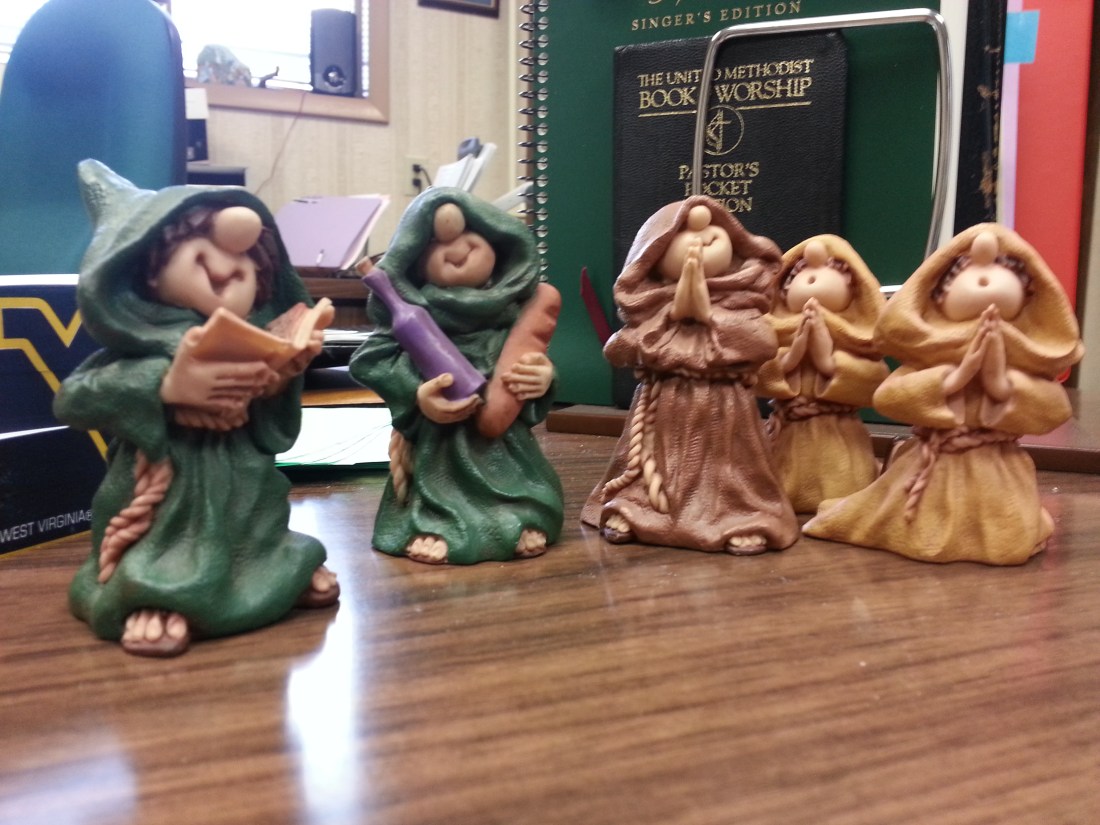
The Hazan
One of the Hazanim


gc prayerWhen my brothers and sisters in the faith (and a daughter by blood among them) come together in just a few weeks in Portland, there will be much that has been read and even more that will be said. I know that many prayers are being shared for this holy gathering of people who must worry about words. I only hope the one I add is read by a few, spoken by more, and heard by the only One that matters.

A Prayer for Portland 2016

Gathered from scattered gatherings of the very same clan
They flock and nest in one place for weeks.
To reproduce? To create? To be recreated?
To hold fast? To change? To paint a brighter future?
To hope.

No one knows what will really happen but my prayer is this:
Let your words, whatever words you share,
even the ones in the deepest, darkest corners,
of the unseen places of your heart, be words of life.

Speak those words to life and let all others die the death of the Accuser.

Leave as one, returning to places where clans gatherHope
To share One,
To reproduce,
To create,
To offer recreation,
To hold fast,
To change,
To speak a brighter future into existence
with words that cannot fail.

Leave as one…to hope.

On Children at the Border

CrisisAtTheBorder
Https://lirs.org

Yesterday, I had the privilege to listen to Krista Tippett, host of NPR’s On Being, interview the (self-described “morose”) author, television and print journalist, Richard Rodriguez. Their conversation covered a lot of ground but part of it covered our current immigration crisis. Rodriguez sees this “problem” with very different eyes. The problem is here  and not in the scores of people who are making their way to our borders. The land of opportunity has so many people in it who feel the need to escape this terrific country that they fuel a drug industry that in turns allows thugs to take over countries to our south and send people – especially children – looking for a better life. Where do they look? The land of opportunity, of course.

I think that is a fascinating way of looking at it. Its a tragic comedy in many ways and one in which Rodriguez also pointed out was being played out with the voice of the Church being strangely silent.

That silence troubled me most of the day yesterday. I wondered why I hadn’t said more. I wondered why my church hadn’t said more and I even thought, “I think I know more people who would be upset that I was listening to a gay man suggest to the church that we could do more than there are people who are upset that we are expediting the return of children to places of death.”  I prayed a lot about it yesterday and today and the following came to me:

Father of all people everywhere, bless the new Americans who come in year by year from foreign lands. Help them in their loneliness to find friends, to get work and to be happy. May they feel that America is their country.

Help us, as people from all countries, to live together in this great world-nation. May we forget all difference in color and language and work for the future of our land, seeking to make it a home of freedom and brotherhood. Help us be more considerate of these immigrants, remembering that they may have more to give to American than we have. May we never speak disrespectfully of them, but treat them as our brothers and work with them for a greater America.

Now, I say these words “came” to me, but they are not my own. They are the words of Robert Bartlett found in the hymnal The New Hymnal for American Youth, copyrighted in 1930 by The Century Company.

I picked this hymnal up to look at it to see just how “dated” the hymns and prayers would be for our day and age. God laughed. I got the joke too. Granted the language is a bit more masculine than I would like but the words of that prayer are haunting. These children of God showing up on our borders are not a problem to be solved! They are our future brothers and sisters in faith and future patriots of this nation.

That’s apparently how it used to be so it makes me wonder about the terrific “conservative” voices I hear today saying we should send everyone back as quickly as possible: Just what are we conserving here? The American Dream or our slice of the pie.


On Capital Punishment

During the “Pray-As-You-Go” exercise for Good Friday, I was challenged to imagine myself as one of the people in Jesus’ group o041314_1740_ACrossBetwe1.jpgf family and friends who were witness to the execution of Jesus on the cross. I found this very difficult. It wasn’t that I couldn’t imagine the scene – I have seen so many depictions of it in art and movie that my imagination didn’t have to work very hard – it was that I found that I could not remain among the group of people who were there with Jesus. My mind kept slipping over to view this scene from the perspective of the family members of the others who were being executed by Jesus. (If you want to read what became of this imaginative exercise, you can click here.)

Granted, the fact that Jesus was killed between two thieves has been something that has captured my theological imagination for quite some time. What does it mean that “a completely innocent man” was killed in the name of the state between two people who were also “convicted” of capital crimes?

Part of me imagines that Jesus would have chosen to be killed in exactly this way. He spent his life hanging around those who had reputations that were less than stellar. I think that it is only fitting that the man who gave up heaven to walk the earth spent his last few breathes on public display with exactly the type of people he loved the most – those who were always on the outside of any faith based on legalism. What were the crimes of these convicted felons? I know we have certain standards in our world today for executions, but what are those standards really based upon? And this says nothing of the “figurative” way that people are killed in the name of a group of people in power. I think of all the people who are ostracized by “the Church” in the name of legal interpretations of our Book as well. What about these people? Is Jesus still handing on a cross beside them and waiting for us to notice? It even happens in our communities. Not very long ago, a man in our community took his own life after being investigated for child pornography issues. Yesterday a man in South Korea took his own life rather than face the relatives of the children killed in a tragic ferry accident. What do these things say about us as a people? I know that this is not “capital punishment” but what does it say about our ability to stand with those who commit crimes or even those facing the tragic circumstances of which they played some part? Those who follow Jesus should be able to offer some hope, some joy, for even the worst among us. Jesus managed to do it on the cross.

Another part of me wonders about the justice issues that we as Christians cannot deny exist when we look at the cross. An innocent man was killed “by the state” for crimes he was convicted of by the judicial system of that day. Even an attempt at some sort of pardon by the state failed. It stands to reason, at least for me, that those who were hanging on the left and right of Jesus of Nazareth could have just as easily been every bit as innocent as Jesus. (Granted, one of those two confesses his crimes on the cross, but still, I have to wonder about any system that finds justified killing in the name of the people of a state somewhat suspect.) I know the stance of my church on this issue:

The Death Penalty

We believe the death penalty denies the power of Christ to redeem, restore and transform all human beings. The United Methodist Church is deeply concerned about crime throughout the world and the value of any life taken by a murder or homicide. We believe all human life is sacred and created by God and therefore, we must see all human life as significant and valuable. When governments implement the death penalty (capital punishment), then the life of the convicted person is devalued and all possibility of change in that person’s life ends. We believe in the resurrection of Jesus Christ and that the possibility of reconciliation with Christ comes through repentance. This gift of reconciliation is offered to all individuals without exception and gives all life new dignity and sacredness. For this reason, we oppose the death penalty (capital punishment) and urge its elimination from all criminal codes.

From The Book of Discipline of The United Methodist Church – 2004. Copyright 2004 by The United Methodist Publishing House. Used by permission.

Is it possible that even one innocent person is killed today? I can’t imagine that we are that much better than those who led in Jesus’ day. Things do happen. People do let their eyes be blinded by certain preconceived notions of what is happening. I know I do.

And yet, at the same time, I hear so little about it…especially as it relates to the way we sometimes “kill the spirit” of those who are convicted of other crimes in the Church. Both are serious problems that our society and church face today.

Sunrise over Princeton, WV
Sunrise!

I know…pretty serious thought for the Saturday before we celebrate the Joy of Easter. However, I had to get this off my mind. As I go through this day and even tomorrow, I hope I find myself praying for all those who are on “death row” these days, in our prisons, in our communities, and in our churches. I know that Jesus is with them still. I know Jesus would offer hope. I know that since “joy is the serious business of heaven” (C. S. Lewis) then that same joy should be our serious business as well – “on earth as it is in heaven” and all.

May the Joy and Hope of Easter be with us all!

Getting Rid of a Killer

My heart and mind is still filled with images and overwhelmed with emotions about the school shooting in Newtown.  As a pastor, I am dealing with parents and others looking for answers where there are none but I am offering them the Hope that this season of Christmas promises and praying that we will see God’s Light in the darkness.

I have had many conversations with people about “how to stop” these kinds of things from happening – fixing our mental health system, stricter gun laws, safer schools, etc.

I want to say that I don’t have the complete answer to solving that problem.  I read a haunting article on the first school bombing which took place in 1927 where 45 students and teachers were killed.  It made me take a very deep breath and realize that this is not a problem of our generation – it is a problem of our human nature.  It is a problem that only the God we find in a manger and on a cross can solve.

Yes…we must do ALL we can to make things safer but we must also do all we can to expose the darkness to the Light so that real change can take place.

At the same time that all this has been happening, I have been meeting with a group of people who wanted to study about how they could have “A Different Kind of Christmas.”  It has been a wonderful study.  We cried a lot as conviction ran through us.  We laughed at ourselves and the ways we get caught up the commercialization of this Holy Day.  We promised to look at ways we really can change the way we celebrate this holiday. We made plans for next year so we would not be facing the same convictions. And…we talked about living simply so others could simply live.

Personally, I have made a commitment to get rid of a killer. Watch this:

At least half of everything I receive at Christmas this year will be going to rid the world of the killer that is malaria. We may not know how to stop a shooter in our schools (yet), but with just ten dollars, I know that I can buy a mosquito net that will stop this other killer from taking the life of a child. I have been “texting” donations during worship. I am setting aside money to send in to “Imagine No Malaria” and I have just been letting everyone I know that this is something that captures my passion.Imagine-No-Malaria-Logo-3

I have even gone so far as to try and get the Imagine No Malaria team to send confirmations of text donations on Christmas Eve that include a picture of a candle, so that we can have “two” candle lighting services at Christmas Eve this year.  (Those of you who go to Christmas Eve services and have cell phones…think about it…let your imagination go for a minute!)  I don’t know if the folks at INM have worked things out with mGive.org yet, but I am still praying that they will.  (mGive, United Methodist Communications and Imagine No Malaria are all great groups…I just pray that they can capture this vision as well.)

INM Logo 2At the end of our “Different Kind of Christmas” study, the group I was with gave Jesus a wonderful gift in my name. Together, our class gathered enough money to buy ten more nets.
It may not sound like a lot to you – but think of it as ten more children getting to live.  Ten more parents not having to grieve.  Ten more people laughing and hugging and celebrating Jesus’ birthday.

I think Jesus would like that!

See you on the way home…and know that on Christmas Eve, I will be texting “MALARIA” to 27722 in order to send another $10 to get rid of a killer that can be stopped.